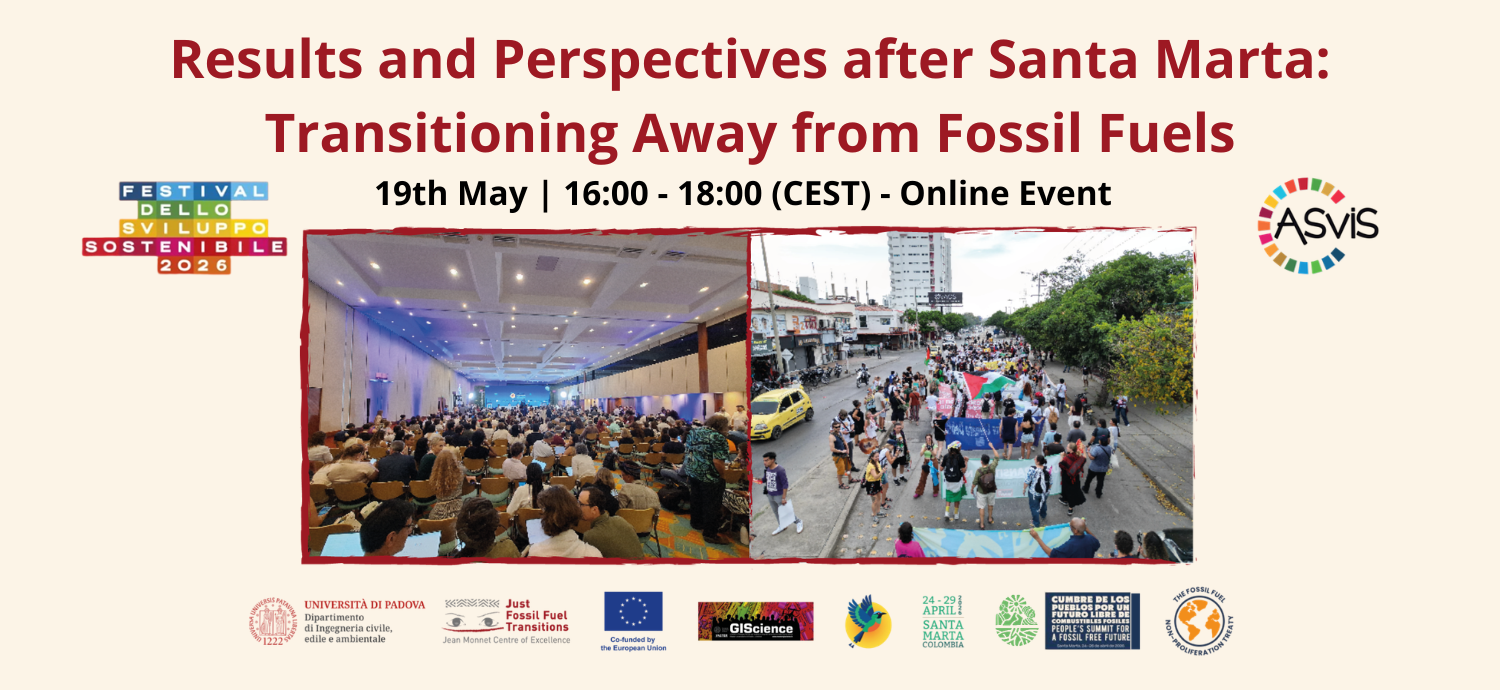
The Jean Monnet Centre of Excellence on Just Transition from Fossil Fuels is pleased to invite you to an online event on 19th May from 16:00 to 18:00 (CEST) to share reflections, thoughts, and the main outcomes emerging from the first international conference on “Transitioning Away from Fossil Fuels” in Santa Marta, Colombia.
The event will be online and in Italian – REGISTER HERE TO PARTICIPATE
DOWNLOAD THE FLYER OF THE EVENT
The event is part of the framework of the Sustainable Development Festival 2026, promoted by ASviS, which represents the main Italian contribution aimed at highlighting the 17 Sustainable Development Goals (SDGs) and the cross-cutting dimensions that characterize the 2030 Agenda, fostering progress toward sustainable economic, social, and environmental development.
The First International Conference on Transitioning away from Fossil Fuels was a unique moment of convergence for the global climate diplomacy, seeking to address the current challenges of the climate crisis in an intersectional, collective and horizontal way, within a context marked by escalating global conflicts and the weakening of international geopolitical relations.
Undoubtedly a historic milestone, it follows 30 years of negotiations and failed multilateral treaties, with global leaders coming together to chart a path towards transitioning away from fossil fuels. Involving, 57 countries worldwide, which have already voluntarily joined this effort, representing more than half of global GDP, 30% of the world’s population and around 20% of global fossil fuel production together with sub-national institutions, academia, civil society, social movements, Indigenous nations, and Afro-descendant communities.
This voluntary roadmap, independent from formal climate governance, was promoted at the end of COP30, held in Belém (Brazil) in 2025, with the aim of advancing a pathway toward the fair and just phase-out of the fossil fuel sector, grounded in the protection of human rights and the principles of climate and social justice.
The Jean Monnet Centre of Excellence on Just Transition from Fossil Fuels have participated as academics and members of civil society in the various sessions held in Santa Marta. Their academic contribution presented scientific research on the geovisualization of territories for spatial justice, based on multi-criteria geographic analyses aimed at envisioning and defining just transition pathways.
Approximately one month after the conference, the event proposed aims to critically reflect on the strengths and limitations, impressions, insights, and perspectives that emerged throughout the different phases of the conference.
The event will be online and in Italian – REGISTER HERE TO PARTICIPATE
