21 September 2026 – Press release | Download PDF (ENG | ESP | ITA )
Authors: Francesco Facchinelli, Alberta Pavone, Edoardo Crescini, Giuseppe Della Fera, Donald Rafael Moncayo Jimenez, Pablo Fajardo Mendoza, Salvatore E. Pappalardo and Massimo De Marchi
A new study published in the open access journal Environmental Research Letters and led by the Jean Monnet Centre of Excellence on Just Fossil Fuel Transition and the International research group “Climate Change, Territories, Diversity” (Dep. ICEA) at the University of Padova and the Unión de Afectados y Afectadas por las Operaciones Petroleras de Texaco (UDAPT) presents an updated picture of gas flaring activity situation in the Ecuadorian Amazon Region since the Sucumbíos Court ruling ordering the progressive closure of gas flaring operations supporting the campaign Apaguen Los Mecheros, Enciendan La Vida!. The paper is available in Englsh in the publisher website and in Spanish in the web page of the Centre of Excellence Jean Monnet on Just Fossil Fuel Transitions.
Results show incongruences between the ruling, scientific evidence and actual oil operations, reporting 47 new gas flaring sites and the presence of flaring activities within sites where the Ministry of Energy and Mines declares to have eliminated stacks. The study also provides an updated dataset on gas flaring activities following the participatory mapping carried out in 2019 through extreme citizen science methodologies estimating between 198 and 252 flaring sites potentially active and reports a set of dubious practices such as gas venting and Enclosed gas flaring.
The authors put forward three recommendations for the Ecuadorian state: 1) to advance efforts in natural gas valorisation, which would also be economically sound; 2) to monitor compliance with the ruling effectively, including by oil companies, adopting scientifically sound references on the impacts of flaring; and 3) to make data on gas flaring and on the oil industry publicly available, as required by the Escazú Agreement.
The study shows how open-access remote sensing, combined with extreme citizen science-generated ground evidence, can support independent, transparent and scalable verification of environmental compliance in politically contested extractive frontiers. It also shows why ground evidence and independent monitoring activities remains indispensable to have a ground-truth and real comprehension of the gas flaring activities which can remain understate from official reporting data and remote sensing analyses as presented below.
CONNECTING GLOBAL CLIMATE AND LOCAL ENVIRONMENTAL JUSTICE: MONITORING THE BAN ON GAS FLARING ACTIVITIES
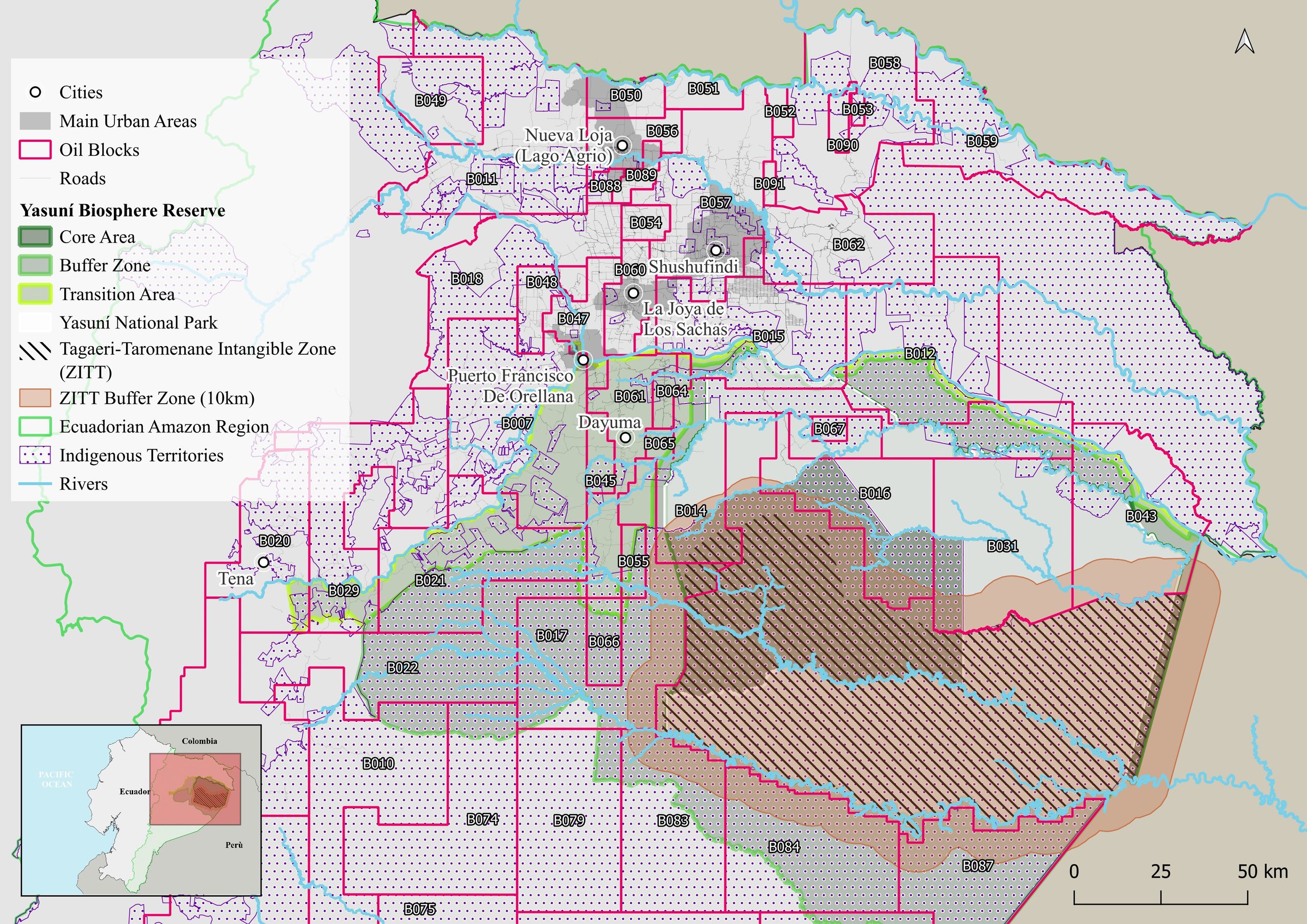
The study focuses on gas flaring activities and its socio-environmental impacts in the Ecuadorian Amazon Region. Ecuador is one of the one of the 17 megadiverse countries in the world, owing to its exceptional cultural and ecological diversity. The EAR, which represent only 2% of the entire Amazon basin, hosts high levels of biodiversity, endemism and Indigenous nationalities, one of which, the Tageari-Taromenane remains uncontacted. Moreover, the Yasuní National Park and the Biosphere Reserve of Yasuní, owing to their its high ecological and cultural values, are unique worldwide and rank among the most biodiverse areas on the planet. The overlap with oil concessions highlights the contradictory planning of a region that has been turned into a sacrificial zone (Fig.1).
Gas flaring activities, at the centre of this study, is the combustion of associated and excess gases generated during oil extraction and production processes. This practice is widely recognized as inefficient and environmentally unsustainable, and its phase-out has become a priority within international frameworks targeting climate and energy transition goals. Global flared volumes at upstream oil and gas facilities reached 167 billion cubic metres (BCM) in 2025, marking the highest value since 2019. Total carbon emissions from flaring are estimated at around 380 million tonnes annually, or approximately 1 percent of total global carbon emissions.
The paper is part of a long-standing, independent and self-funded research project to support local organisations struggle against fossil fuel extractivism. On January 26, 2021, the Court of Nueva Loja ordered the shut-off of all gas flaring sites near populated centres within 18 months, and the complete end of flaring by 2030. This new study, grounded in an eight-year Extreme Citizen Science process, investigated whether and how that ruling is being applied.Following the 2021 ruling, the Ministry of Energy and Mines in 2022 adopted the “Regulations for the Progressive Reduction of Routine Flaring of Associated Gas in Flare Stacks”. These defined the flares “near populated centres” targeted in the first phase as only those located less than 100 metres from a populated centre – a threshold borrowed from Alberta (Canada) Directive 060. Applying it to a baseline of 486 flare stacks, Petroecuador identified just two flares within the prohibited range, both at the Lago Central Station, and private companies none at all. The Ministry subsequently declared that 110 sites had been closed under Phase I of the ruling. However, as shown in previous work by the same group, the environmental and social impacts of gas flaring extend well beyond the 100 m threshold. That study also found that 294 of the 295 flaring sites mapped in the Amazon are close enough to pose a potential risk to at least one populated centre, that 180 communities are simultaneously exposed to emissions from between 6 and 18 flares within a five-kilometre radius; and that between 12,000 and 100,000 people could be affected, considering only the cities of Lago Agrio, Joya de los Sachas, Shushufindi and Puerto Francisco de Orellana.
Monitoring the ban application: an updated picture of gas flaring in the Ecuadorian Amazon
Combining thirteen years of satellite observations with a dedicated field campaign, the study shows that gas flaring in the Ecuadorian Amazon Region has continued to expand. The number of active flaring sites detected by the NOAA Nightfire algorithm rose from 58 in 2012 to 91 in 2024, while the estimated volume of gas burned each year more than doubled, from 0.82 to 1.69 BCM. Far from declining after the ruling, flared volumes grew by a further 0.32 BCM – 22% – between 2022 and 2024, reaching an all-time high (Figure 2b).
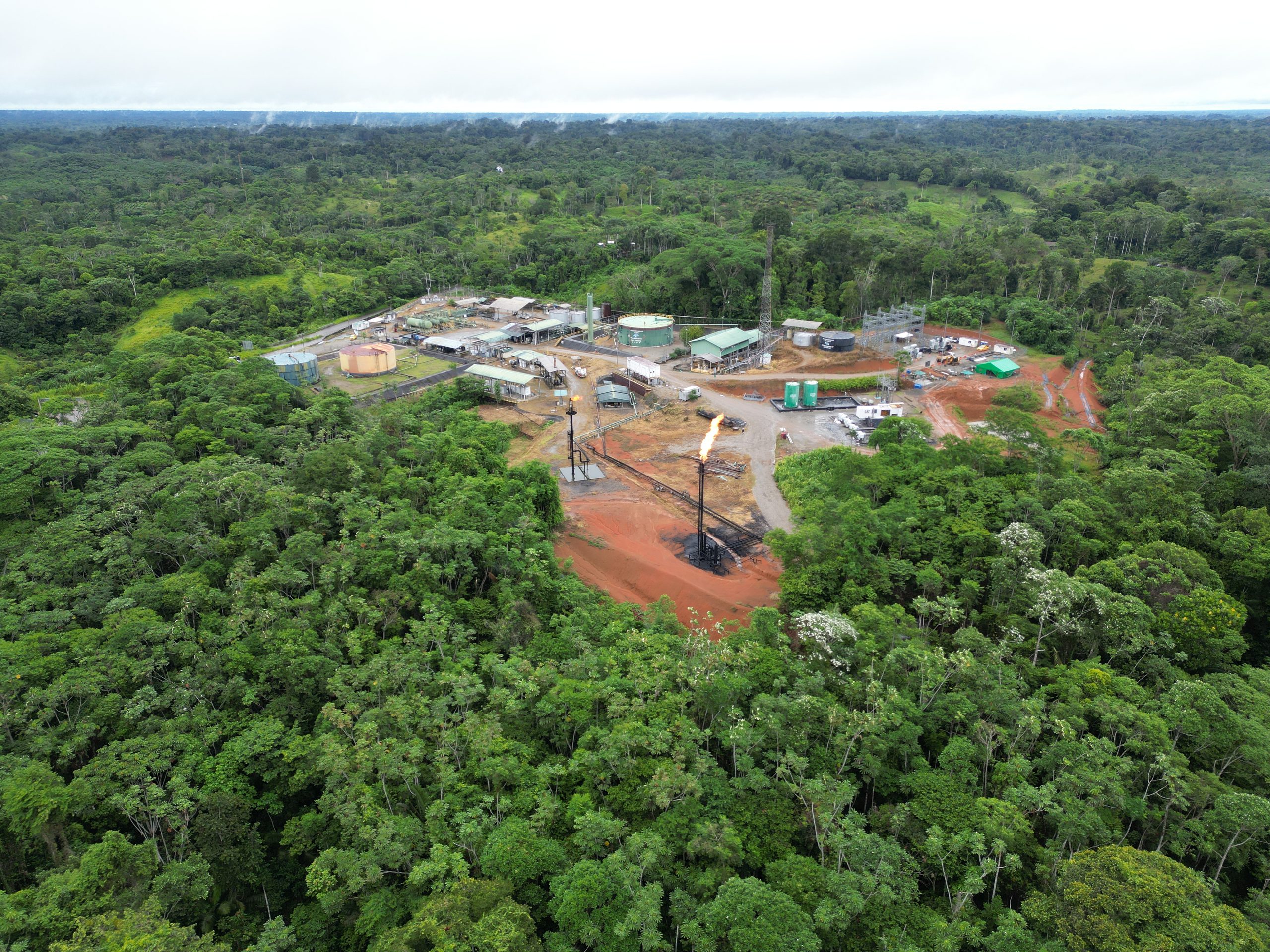
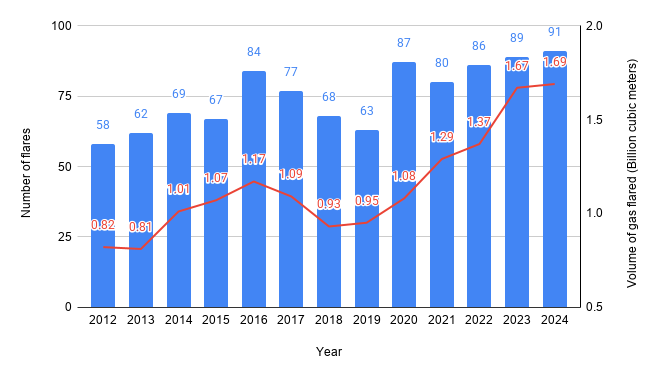
Figure 2. a) A gas flaring site in the Ecuadorian Amazon Region (0°3’32.08″S, 76°39’10.47″W), Shushufindi oil field, Sucumbíos, 06/05/2026; b) Volume of flared gas and number of gas flaring sites per year in the Ecuadorian Amazon Region (2012–2024), as detected by the VIIRS Nightfire annual dataset.
Daily satellite detections and the 2026 ground-mapping campaign jointly identified 47 flaring sites that were absent from the 2019 dataset. Many are concentrated in oil blocks that only recently started or resumed operations: nine sites in blocks 50, 51, 88 and 89 operated by Gran Tierra Energy, and five in block 46 operated by the Chilean company ENAP. Companies opening new operations therefore appear not to be adhering to the ruling’s call for a gradual and progressive phase-out of flaring.
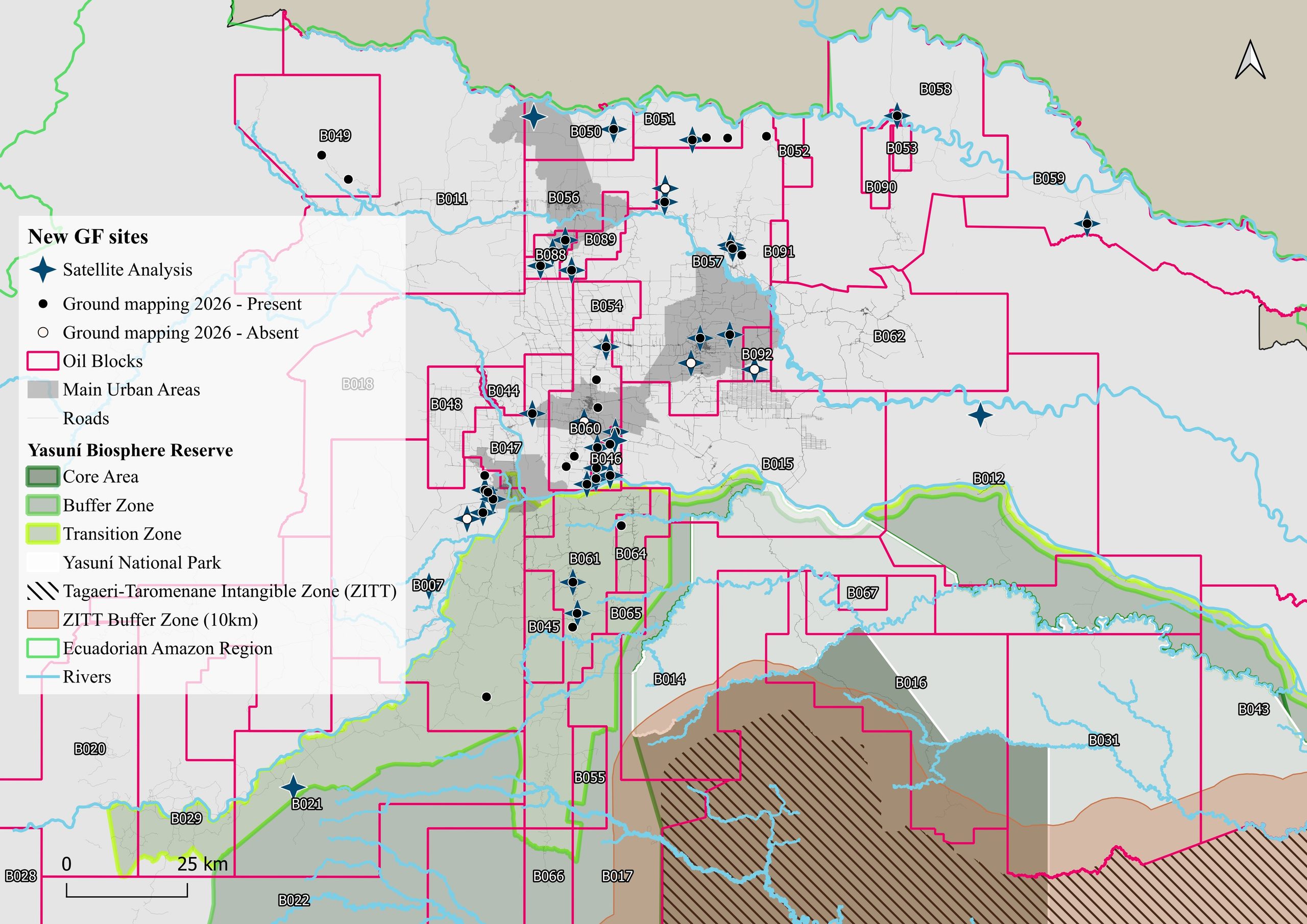
Petroecuador reported having dismantled 110 flares under Phase I of the national reduction plan. Cross-checking those locations against satellite detections and field evidence, the research team established the current status of 72 of them: 37 sites, or 51%, were found to still have active stacks, while 35 were confirmed inactive (Figure 4a). Although this may have several explanations – for example the closure of only one of many stacks at the same site, which does not necessarily mean a decrease in the volume flared there — it raises doubts about the criteria used to identify the flares to be shut off.
The analysis of stack heights adds a further element. The flares that were shut down are significantly shorter than those still in operation. In other words, dismantling has concentrated on the smallest installations, while larger facilities – several of them close to urban centres – continue to operate and even to expand. The pattern suggests a territorial reconfiguration of oil operations, in which smaller sites are closed while their gas is redirected to larger ones: a centralisation of flaring rather than an actual reduction (Figure 4b).
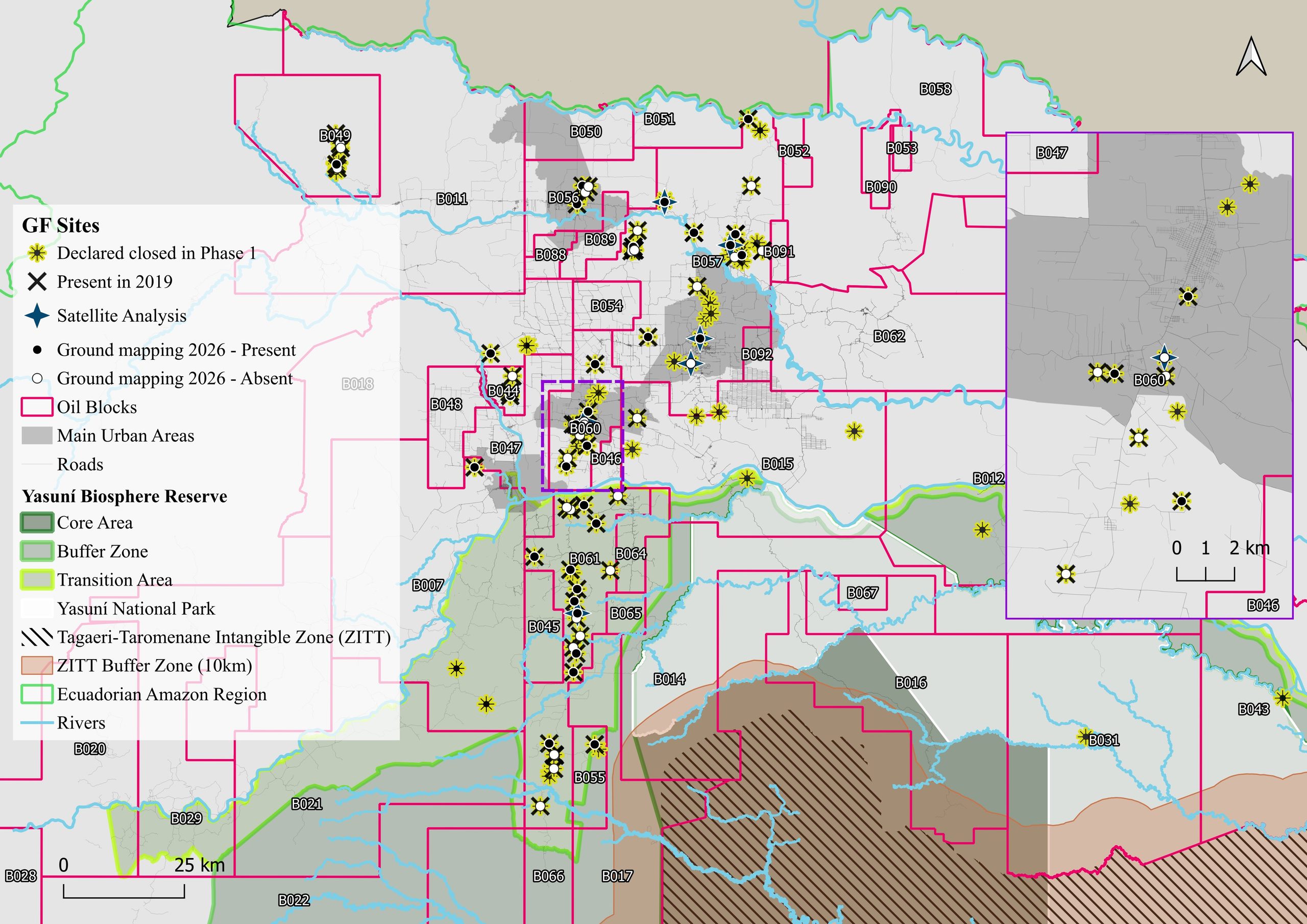
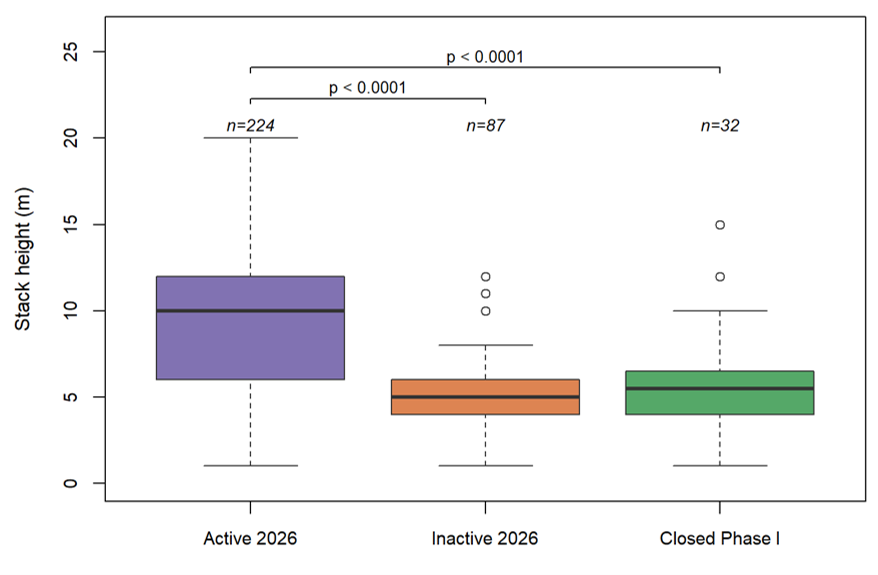
Figure 4. a) Activity status of the 110 gas flaring sites reported as dismantled under Phase I, as assessed through satellite detections and ground mapping. b) Gas flaring stack heights (m) in the three groups: stacks found flaring during the 2026 campaign (224 stacks at 172 sites, heights measured in 2026, including sites newly recorded in 2026), sites mapped in 2019 and found without stacks in 2026 (87 stacks at 75 sites, heights recorded in 2019), and the platforms listed among those closed under Phase I of the Protective Action compliance process (32 platforms at 28 mapped sites, heights recorded in 2019).
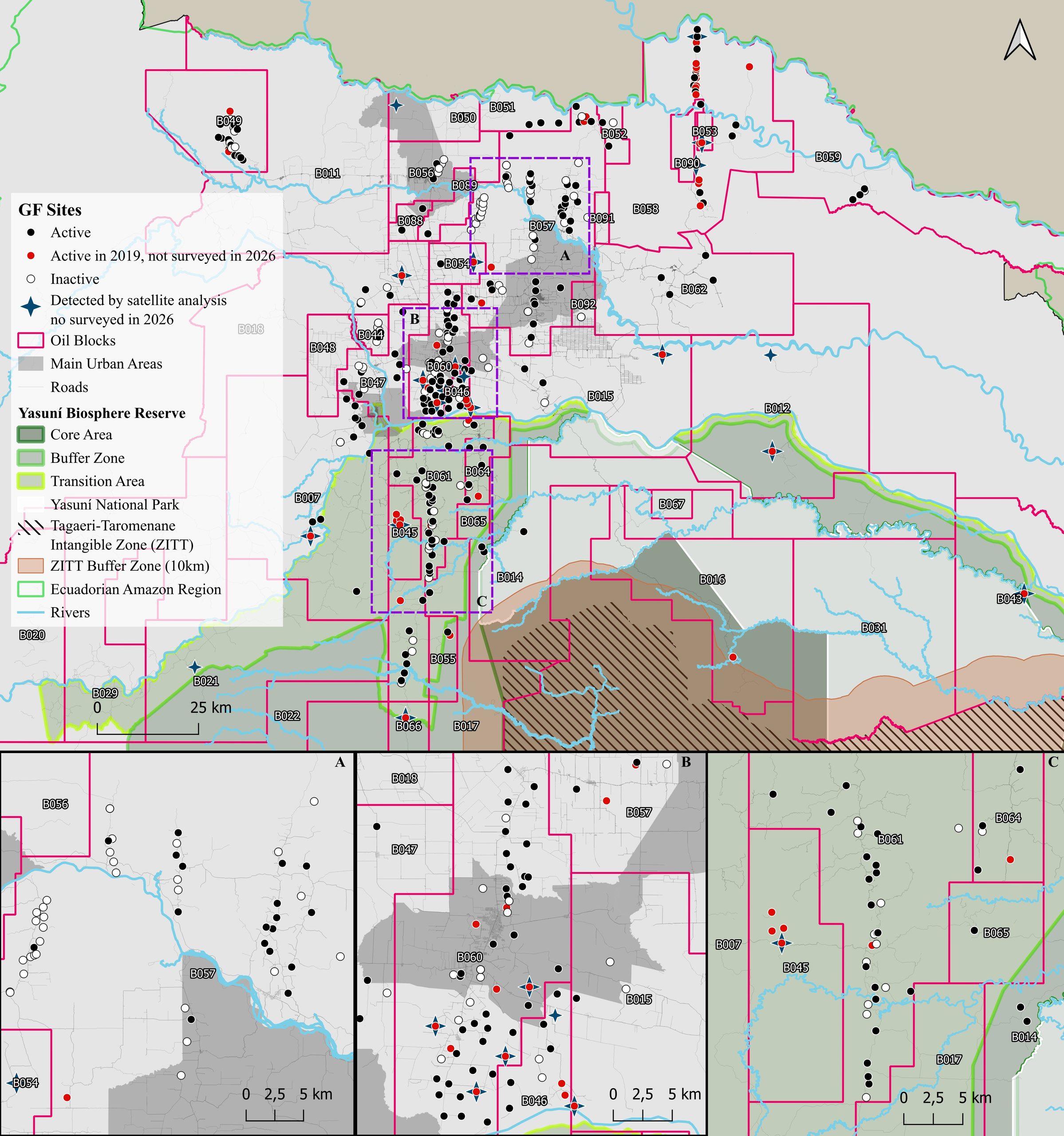
Bringing together all sources, the study provides an updated inventory of between 198 and 252 potentially active flares across the region, against 91 sites confirmed as dismantled (Figure 5). The lower bound counts only sites with proven ongoing activity, confirmed either on the ground or through high-resolution satellite imagery; the upper bound also includes 57 sites whose status could not be established.
| Active 2019 | Active 2026 | Inactive 2026 | Closed Phase I | New Satellite monitoring | New 2026 | |
|---|---|---|---|---|---|---|
| Active 2019 | 295 (53) | 151 | 91 | 62 | – | – |
| Active 2026 | – | 195 | – | 37 | 27 | 44 (3) |
| Inactive 2026 | – | – | 91 | 35 | 5 | – |
| Closed Phase 1 | – | – | – | 110 (38) | 7 | 3 |
| New Satellite monitoring | – | – | – | – | 36 (4) | 27 |
| New 2026 | – | – | – | – | – | 44 |
Escaping the Ruling: how the oil industry evades satellite monitoring
The 2026 fieldwork, which combined ground visits with drone surveys, documented flaring practices largely invisible to satellite sensors and reported here for the first time in Ecuador (Figure 6).
The most significant is the appearance of Enclosed Ground Flares, in which the burner head is housed inside a tube designed to contain radiant heat, luminosity and noise. While presented as a technological improvement, these installations are considerably harder to detect with the VIIRS sensor – the main tool used to estimate flaring worldwide – and even on the ground it is impossible to verify how many flames are burning inside the tube. In practice they create a zone where flaring can continue unobserved.
Nine cases of gas venting were also recorded, in which gas is released directly into the atmosphere instead of being burned; in three of them it was possible to confirm a switch from flaring to venting between 2019 and 2026. Venting is of particular concern because it releases methane, a far more potent greenhouse gas than the CO2 produced by combustion, and because it is effectively invisible to satellites.
The team also documented flares positioned beyond the platform perimeter and beneath the forest canopy, identifiable only through drone surveys, and flaring at wildcatter platforms used during exploratory drilling.
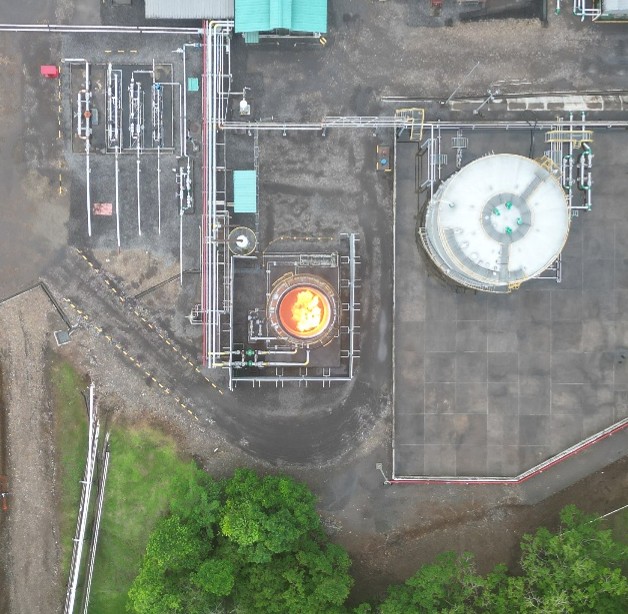
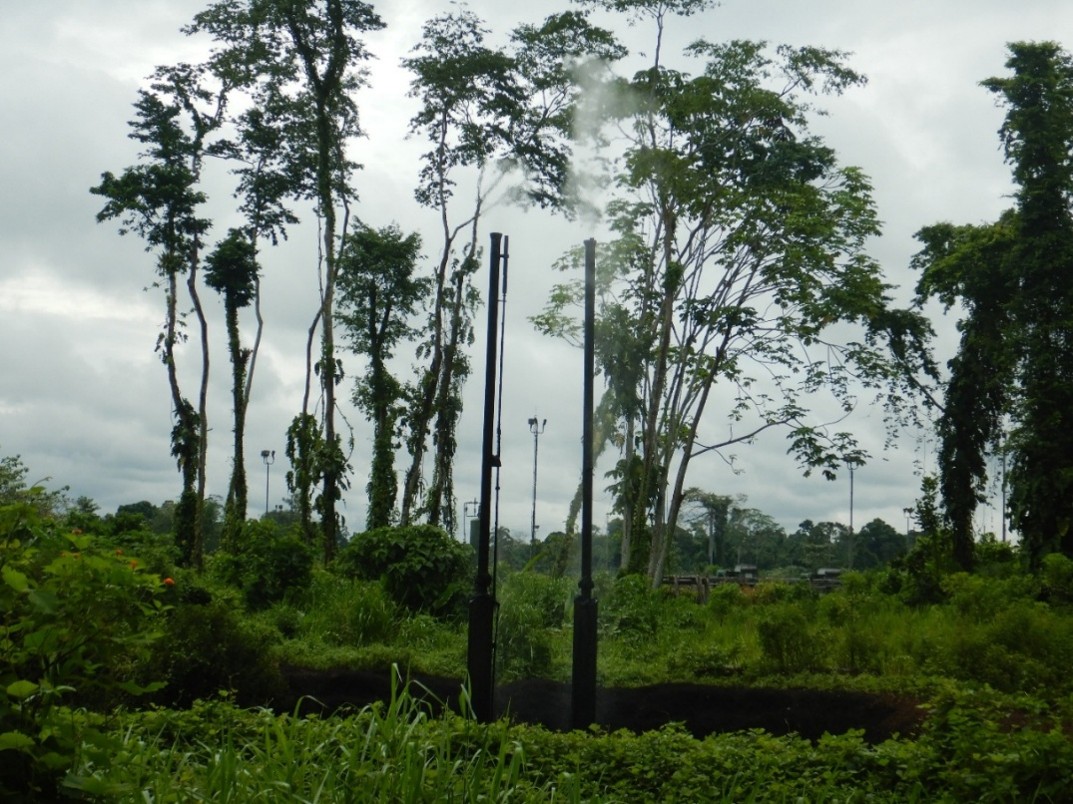
Figure 6. Photos of specific practices at gas flaring sites. a) and b) refer to the same Enclosed Ground Flare in the platform Sacha Pad 198 (0°23’17.49″S 76°48’45.75″W; 10/05/2026) while c) reports a gas venting case in Drago Norte 1 (0°10’13.8″S 76°44’49.3″W, 05/05/2026)
Climate Reflections from the multitude against extractivism and war
The paper is released at a critical moment for a just fossil fuel transition – globally, in the Amazon Basin and in the Ecuadorian Amazon, marked by military escalation and the raise of sovereigntist regimes particularly in Latin America, which are, on the one hand, advancing the extractivism frontiers, and on the other, clearly exposing the fragility of world-wide fossil fuel economies based logistics chokepoint. Indeed, the energy insecurity created by war has driven up oil prices, producing varied impacts across different levels, except for oil companies, which have increased their profits by more than $90 billion since the starting of Middle-Est conflict.
Even through the historic statement from Global Stocktake at COP28 in Dubai called for transitioning away from fossil fuels, unfair international relations and unstable geopolitical context have stalled progress on this momentum. Inaction on the climate crisis have motivated a high-ambitions coalition of governments and a multitude of NGOs, trade unions, parliamentarians, Indigenous and Afro-descendant nationalities, young people, children, feminist and transfeminist organisations, and farmers’ and fishermen’s movements to create a new autonomous and independent space for convergence and coalition-building aimed at dismantling the supply-side of fossil fuels, implementing concrete actions and measures for a just transition. Accordingly, in April 2026, Colombia, supported by the Netherlands, hosted the First Conference on Transitioning Away from Fossil Fuels (TAFF). From the counterpart of the TAFF, the People’s Summit for a Fossil Fuel Free Future, whilst acknowledging the importance of the event, he states that it is necessary to create a forum for dialogue that is ground up, science-aligned and justice-centred pathways toward a rapid, equitable and just transition for territories free from fossil fuels.
In August 2026, more than 2,500 representatives of Indigenous nationalities and of campesino, environmental and social movements met at the XII Pan-Amazonian Social Forum (Foro Social Panamazónico, FOSPA) in Puyo, Ecuador. In their political declaration, they declared a state of emergency for the Amazon, due to the multiple pressures arising from extractivism, climate change and land-use change. Among the points they reaffirmed were the creation of Fossil Free Zones and the demand to end oil operations in the ITT block, a mandate that stems from the national referendum held in 2023. These moments of convergence and collective reflection demonstrate the need to return to the discussion of the climate crisis and to rethink development models, starting afresh from local communities and local knowledge. They are spaces of hope where we are reminded that, although limited, the scope for action still exists.
